
Why the import breaks: eight entry points are gone
Vitest 4 exposed a wide set of subpath imports, letting a custom reporter, coverage provider, or internal tooling script reach directly into Vitest’s own internals. Vitest’s migration guide documents that Vitest 5 removes several of those paths outright, under a section titled Removed Deprecated Entrypoints. There’s no deprecation warning period for these specific paths and no runtime shim; the import simply stops resolving the moment a project upgrades to Vitest 5.
That’s a structural cleanup, not a one-off removal. The guide maps every removed path to a specific, named replacement:
| Removed import | Documented replacement |
|---|---|
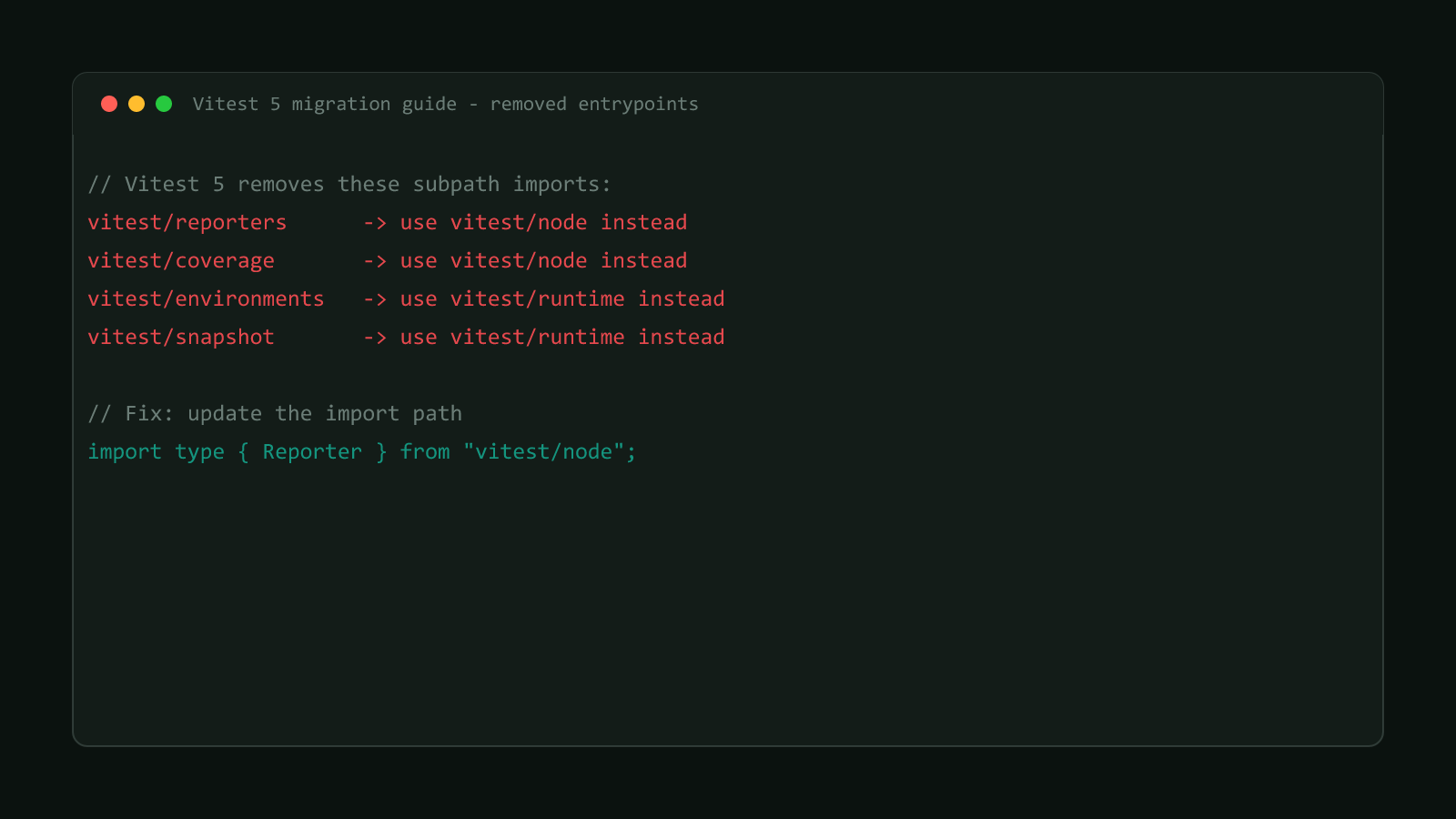
vitest/coverage | vitest/node |
vitest/reporters | vitest/node |
vitest/environments | vitest/runtime |
vitest/snapshot | vitest/runtime |
vitest/runners | TestRunner, imported from vitest |
vitest/suite | static methods on TestRunner, e.g. TestRunner.getCurrentTest() |
vitest/mocker | the standalone @vitest/mocker package |
vitest/internal/module-runner | none documented |
Six of the eight collapse onto two consolidated entry points, vitest/node and vitest/runtime. The other two, vitest/mocker and vitest/internal/module-runner, don’t map onto either: one moves to its own standalone package, the other is gone with nothing named in its place. A project can’t safely assume “swap in vitest/node” is the universal fix; each removed path needs checking against its own row above.
The exact wording of the resolution failure itself varies by bundler and by whether the import is a type-only import, a runtime require, or a dynamic import(), so this post doesn’t quote one specific error string as if every toolchain produced it. What’s consistent across all of them is the underlying cause: the module simply isn’t there anymore at that path, so resolution fails.
Fix it: point custom reporters and coverage config at the new paths
A custom reporter importing from vitest/reporters
import type { Reporter } from "vitest/reporters"; // BROKEN: path removed in Vitest 5

export default class CustomReporter implements Reporter {
  onFinished(files) {
    console.log(`Ran ${files.length} test files`);
  }
}import type { Reporter } from "vitest/node"; // FIXED: vitest/reporters -> vitest/node
export default class CustomReporter implements Reporter {
onFinished(files) {
console.log(`Ran ${files.length} test files`);
}
}A coverage provider importing from vitest/coverage
import type { CoverageProvider } from "vitest/coverage"; // BROKEN: path removed in Vitest 5import type { CoverageProvider } from "vitest/node"; // FIXED: vitest/coverage -> vitest/nodeThe change is mechanical once you know the target: swap the specifier, leave the rest of the file untouched. The type and value exports themselves didn’t change shape in these two cases, only where they live.
Grep before you upgrade, not after
Search the repository for every one of the eight paths in the table above
(vitest/coverage, vitest/reporters, vitest/environments,
vitest/snapshot, vitest/runners, vitest/suite, vitest/mocker,
vitest/internal/module-runner) before bumping the vitest dependency.
Finding all the hits ahead of time turns a broken CI run into a five-minute
find-and-replace instead of a build failure discovered mid-upgrade.
Deprecated, not yet removed: three more packages to watch
Not every change in this area is an outright removal. The migration guide separately flags @vitest/runner and @vitest/ws-client as deprecated, not removed:
“The
@vitest/runnerand@vitest/ws-clientpackages are deprecated as of this release.” They “will no longer receive feature updates, but security fixes will continue to be backported.”
Deprecated still means installed and working today. Treat a dependency on either package as something to plan away from over time, not something that breaks on the next upgrade.
@vitest/browser-webdriverio changes ownership rather than disappearing. The guide documents that this provider now lives under the community-maintained vitest-community/vitest-webdriverio organization instead of Vitest’s own core packages. Anyone pinning the old package path should point at that fork going forward.
@vitest/expect is the subtlest of the three. Vitest 5 stops depending on it internally:
“
vitestalso no longer depends on@vitest/expect: the assertion code is bundled intovitestitself.”
Code that previously relied on @vitest/expect sharing runtime state with the rest of Vitest, rather than just using its type exports, should switch to importing assertions through the vitest entry point directly instead.
Confirmed version range
This site’s own vitest.config.ts is pinned to vitest@^3.0.0, so this exact resolution failure wasn’t reproducible against this repo’s own build; Vitest 5 isn’t installed here. Every claim above is attributed to Vitest’s own migration guide, current as of Vitest 5.0.0-beta.7 (2026-07-24). If you’re on an earlier 5.0 beta, re-check the guide directly, since a beta’s own documented removals can still shift before a stable release. Browse more posts like this in the Guides & Fixes archive, or follow the rest of this Vitest 5 migration series under the vitest tag.