
Why a passing test suddenly fails after upgrading
This isn’t a new bug Vitest 5 introduces. It’s an old bug Vitest 4 was quietly hiding. Vitest’s migration guide states it directly, under “Unawaited Asynchronous Assertions Fail the Test”:
Asynchronous assertions, like
resolves,rejectsandtoMatchFileSnapshot, now fail the test if they are not awaited.
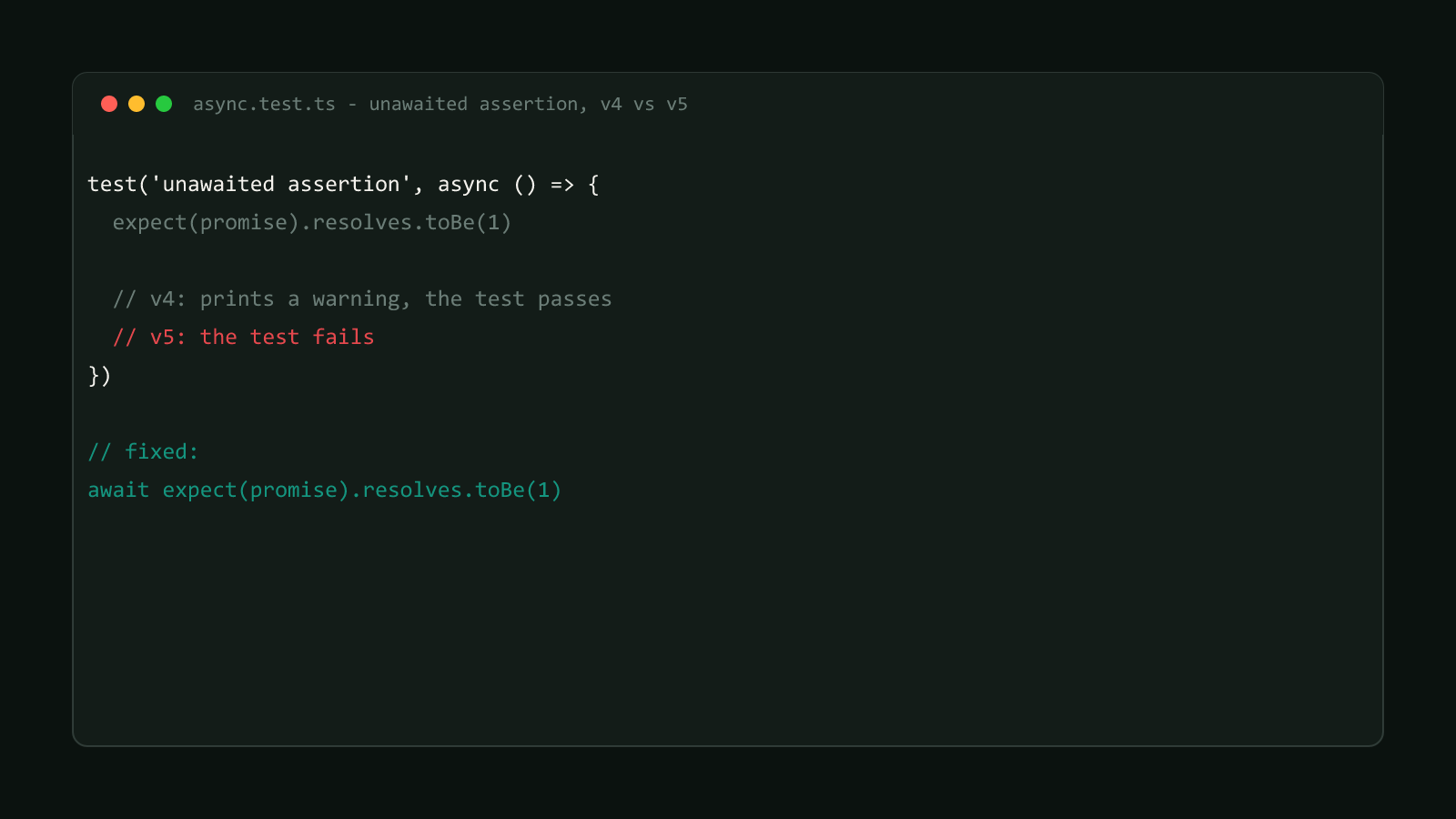
The guide’s own example makes the before-and-after explicit:
test("unawaited assertion", async () => {
  // v4: prints a warning, the test passes
  // v5: the test fails
  expect(promise).resolves.toBe(1);
  await expect(promise).resolves.toBe(1);
});
The mechanical reason this matters: resolves and rejects don’t run the comparison synchronously. Calling expect(promise).resolves.toBe(1) returns a Promise that has to settle before the assertion inside it actually runs. Skip the await, and the test function can finish and report success before that inner promise has resolved at all, which means the comparison it’s supposed to make might never happen before Vitest moves on.
Vitest 4 papered over that gap. It tracked pending assertion promises and auto-awaited them after the test body returned, so the check still ran, just late, with a console warning as the only sign anything was off. Vitest 5 removes that safety net and fails the test the moment it detects an assertion that was never awaited.
Why this is a real bug, not just stricter enforcement
A forgotten await on an async matcher is a latent bug regardless of which Vitest version is running it. If the promise the assertion checks actually rejects, or resolves to something other than what toBe expects, an unawaited assertion in Vitest 4 could still report a green test, because the warning goes to the console, not to the test’s pass/fail result, and nothing forces a developer to read console output on a passing CI run. Vitest 5 turns that same situation into a hard failure, which is the more honest outcome: a test that doesn’t actually verify what it claims to verify shouldn’t be counted as passing.
Fix it: add the missing await
The fix is almost always a single keyword. Find the assertion, add await:
test("resolves to the expected value", async () => {
  expect(fetchUser(1)).resolves.toEqual({ id: 1 }); // BROKEN: promise never awaited
});test("resolves to the expected value", async () => {
await expect(fetchUser(1)).resolves.toEqual({ id: 1 }); // FIXED: assertion runs before the test ends
});Search your suite for the pattern before running it
Grep your test files for resolves and rejects and check each match for a
leading await or a return in front of it. Both work, since returning the
assertion promise from an async test function lets the test runner wait on
it the same way an explicit await would.
Confirmed version range
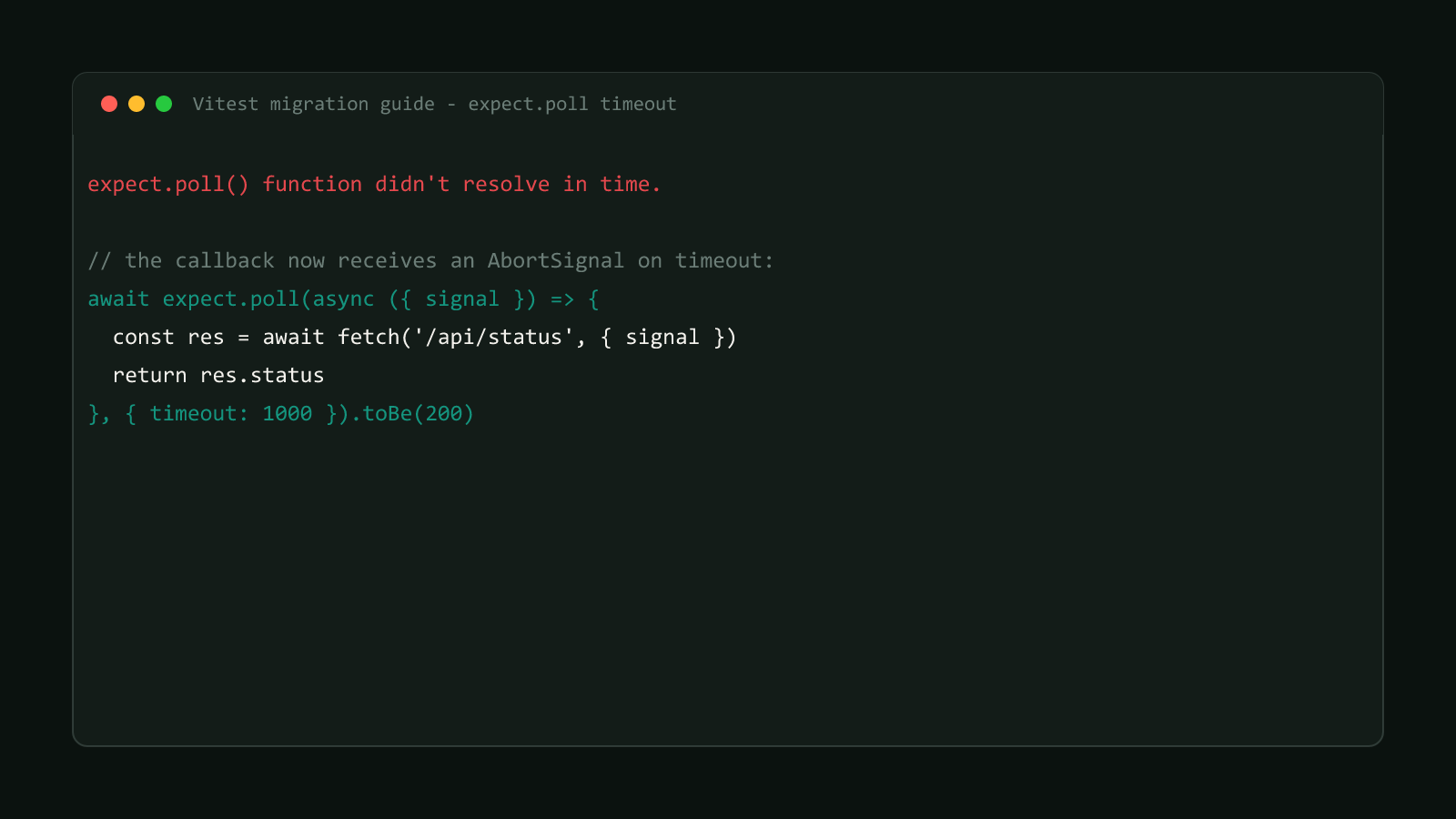
This behavior change is documented in Vitest’s own current migration guide, under “Unawaited Asynchronous Assertions Fail the Test,” as an intentional Vitest 5 change, corroborated as in-window against the beta release available at research time (v5.0.0-beta.7). This repo’s own vitest.config.ts is pinned to vitest@^3.0.0, so this exact failure mode wasn’t independently reproducible against this repo’s own test suite. Treat the mechanics above as documented behavior from Vitest’s primary source, not a first-party reproduction. If you’re also hitting timing changes around expect.poll(), see Fix Vitest 5 expect.poll Timeout Error — a related but distinct Vitest 5 change to how long-running assertions are handled. Browse more posts like this in the Guides & Fixes archive.