
Why a poll that used to pass now throws
Vitest’s migration guide documents this under “expect.poll Fails When It Times Out”:
expect.pollnow rejects when its callback, or the polled assertion, does not settle withintimeout.
The guide gives the exact error text a reader will see, depending on which part times out:
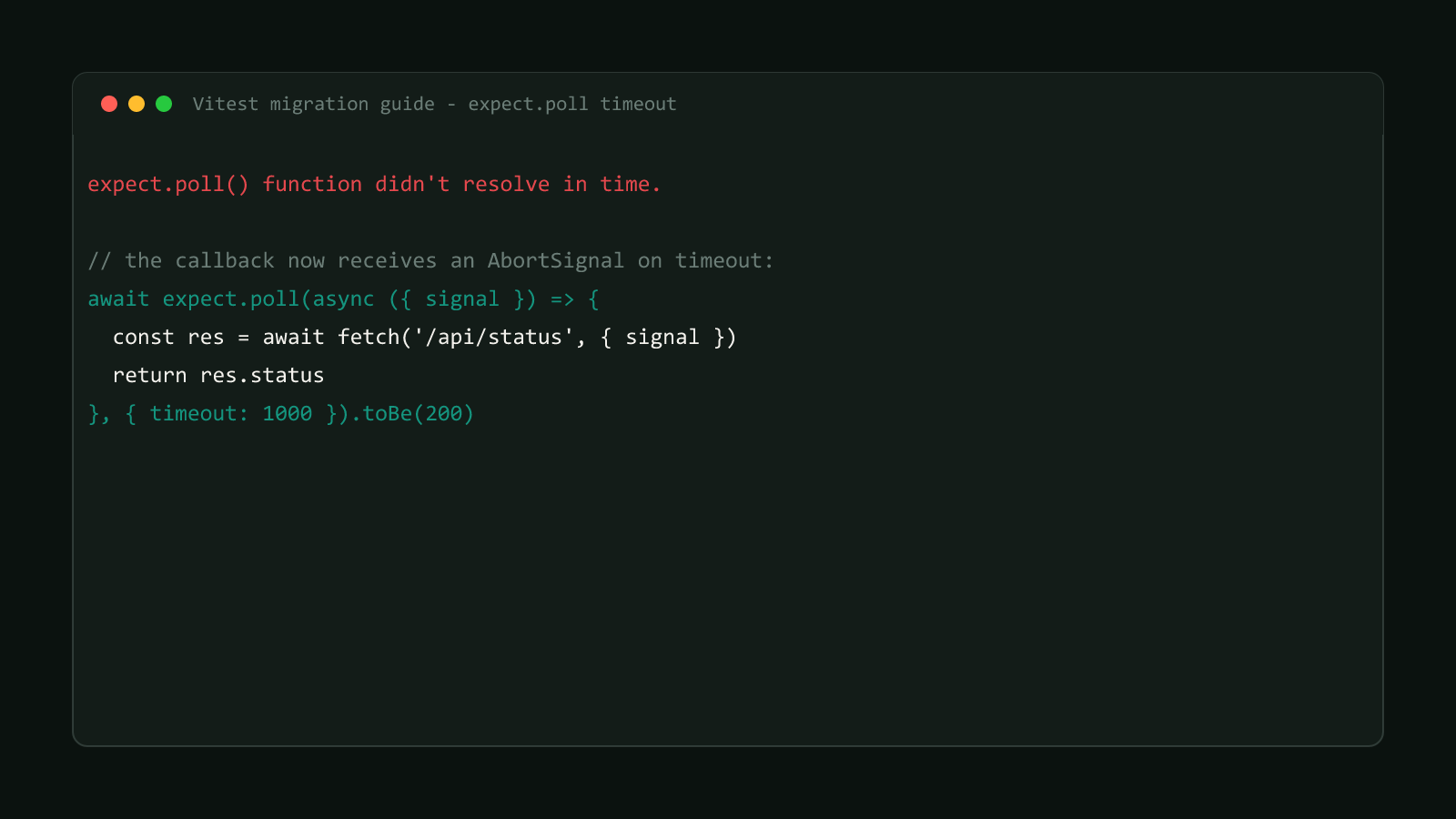
expect.poll() function didn’t resolve in time.
expect.poll() assertion didn’t resolve in time.
The first form fires when the polled callback itself never settles; the second fires when the callback settles but the assertion chained onto it (.toBe(200), for example) never does.
expect.poll() exists to retry a callback repeatedly until an assertion against its return value passes, which is the standard pattern for waiting on a condition that becomes true asynchronously, like an HTTP status flipping to 200 once a service finishes starting. In Vitest 4, the poll loop itself didn’t treat the timeout as a hard stop. If a slow callback or a slow assertion was still in flight when the deadline passed, it could keep going and still report success once it eventually settled, deadline or not.
Vitest 5 changes that to an active rejection. The moment timeout elapses without a settled, passing result, the poll stops and throws the error above instead of letting a late result count.
The new AbortSignal parameter
The same change adds a way to react to that timeout instead of just discovering it after the fact. Vitest’s guide shows the callback now receiving a signal:
await expect
  .poll(
    async ({ signal }) => {
      const response = await fetch("/api/status", { signal });
      return response.status;
    },
    { timeout: 1000 },
  )
  .toBe(200);
That signal is a standard AbortSignal that aborts the moment the poll’s timeout elapses. Passing it into fetch (or any API that accepts an AbortSignal) means the in-flight request actually stops instead of continuing to run in the background after Vitest has already decided the poll failed. Without it, a timed-out poll still leaves that last request hanging until it resolves or errors on its own, which wastes time and can leave dangling handles between tests.
Fix it: don’t just chase the timeout number
A longer timeout can mask a real bug
Bumping timeout from 1000ms to 5000ms makes the error disappear if the
condition eventually becomes true. It does nothing if the condition never
becomes true at all, which is the failure mode this change exists to surface.
Confirm the condition genuinely needs more time before treating a longer
timeout as the fix.
// BROKEN: no signal, so a timed-out request keeps running in the background
await expect
  .poll(async () => {
    const response = await fetch("/api/status");
    return response.status;
  })
.toBe(200);// FIXED: signal cancels the in-flight fetch the moment the poll times out
await expect
.poll(
async ({ signal }) => {
const response = await fetch("/api/status", { signal });
return response.status;
},
{ timeout: 5000 }, // raised only because this endpoint genuinely takes longer to come up
)
.toBe(200);Confirmed version range
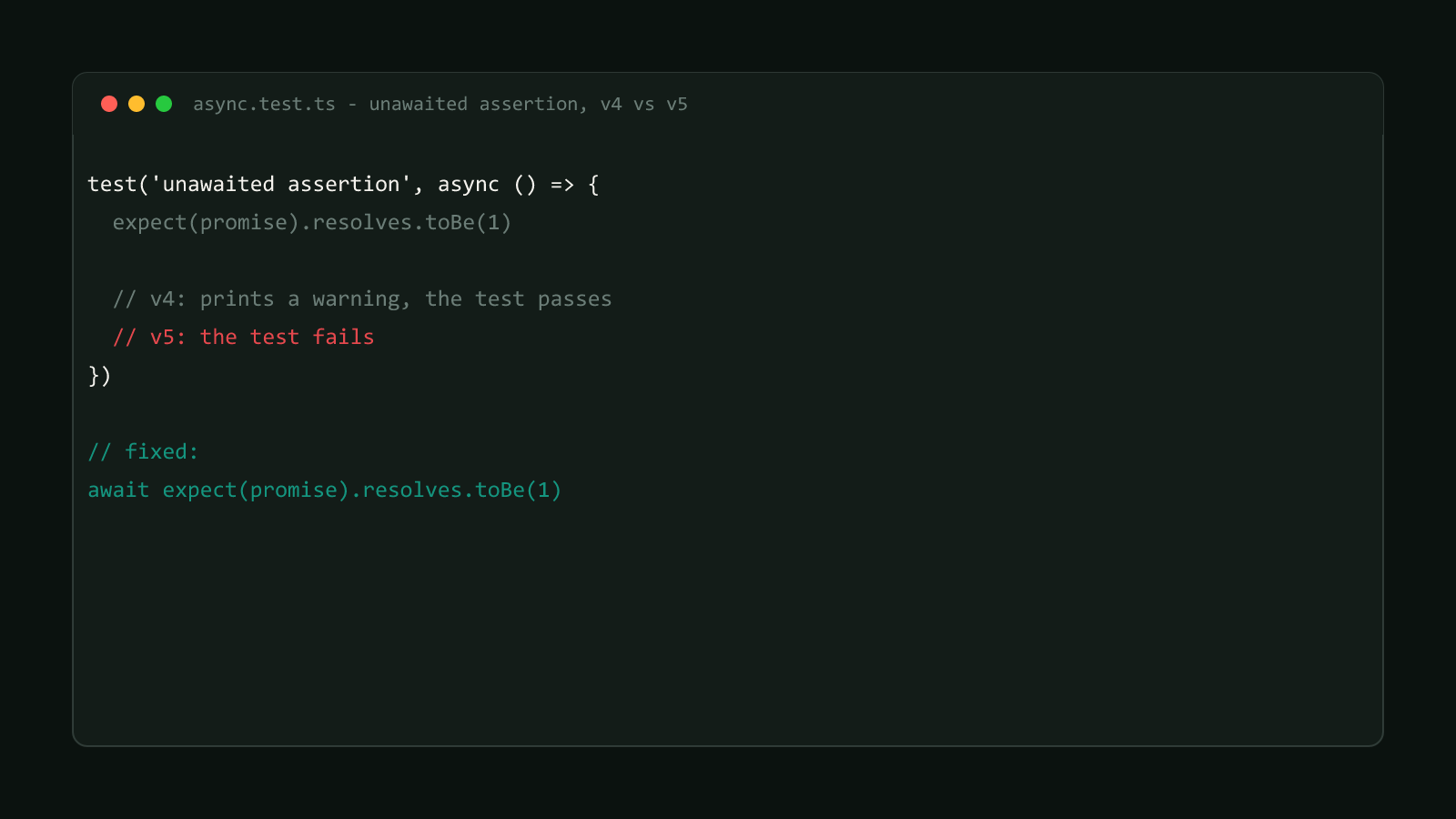
This error string and behavior change are documented in Vitest’s own current migration guide, under “expect.poll Fails When It Times Out,” as an intentional Vitest 5 change, corroborated as in-window against the beta release available at research time (v5.0.0-beta.7). This repo’s own vitest.config.ts is pinned to vitest@^3.0.0 and doesn’t use expect.poll(), so this exact error wasn’t independently reproducible against this repo’s own test suite. Treat the error text above as quoted directly from Vitest’s primary source, not a first-party reproduction. If you’re also seeing tests fail on a forgotten await, see Fix Vitest 5 Unawaited Async Assertion Error — the other Vitest 5 change to how async assertion timing is enforced. Browse more posts like this in the Guides & Fixes archive.