
Three providers, one narrow window
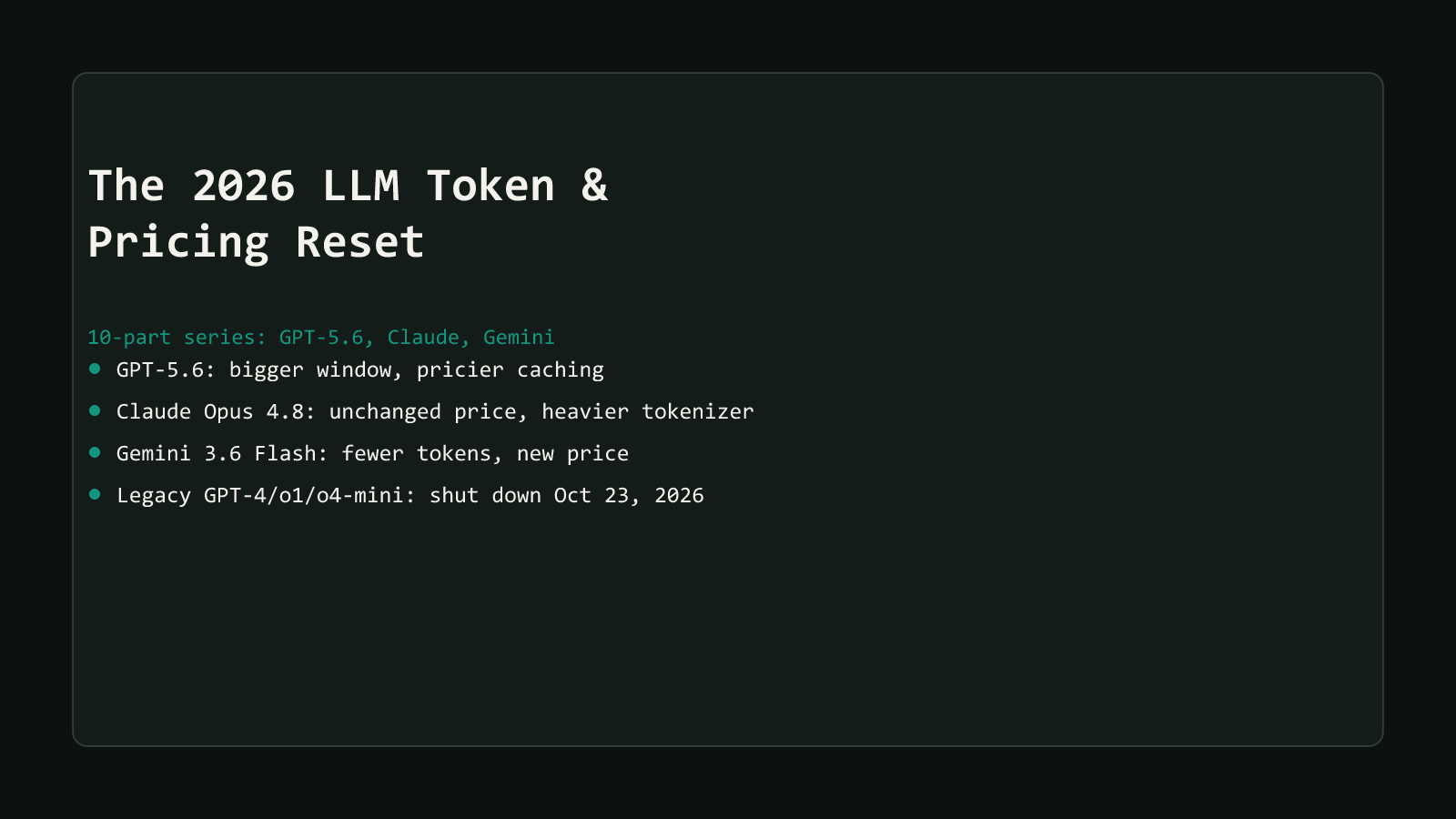
Between April and July 2026, OpenAI, Anthropic, and Google each shipped a model update that touched tokenization, pricing, or both. None of the three coordinated with each other, but the timing overlaps closely enough that a cost comparison written even in early 2026 is already stale on two separate axes: how many tokens your prompt turns into, and what each of those tokens costs.
That distinction matters more than it sounds. A price cut on its own is easy to track, since it shows up as a smaller number on a pricing page. A tokenizer change is quieter. The same block of text can silently turn into more tokens without any price changing at all, and your bill still goes up.
Structural Comparison Matrix
| Provider | Token-count change | Price change | Shipped | How confirmed |
|---|---|---|---|---|
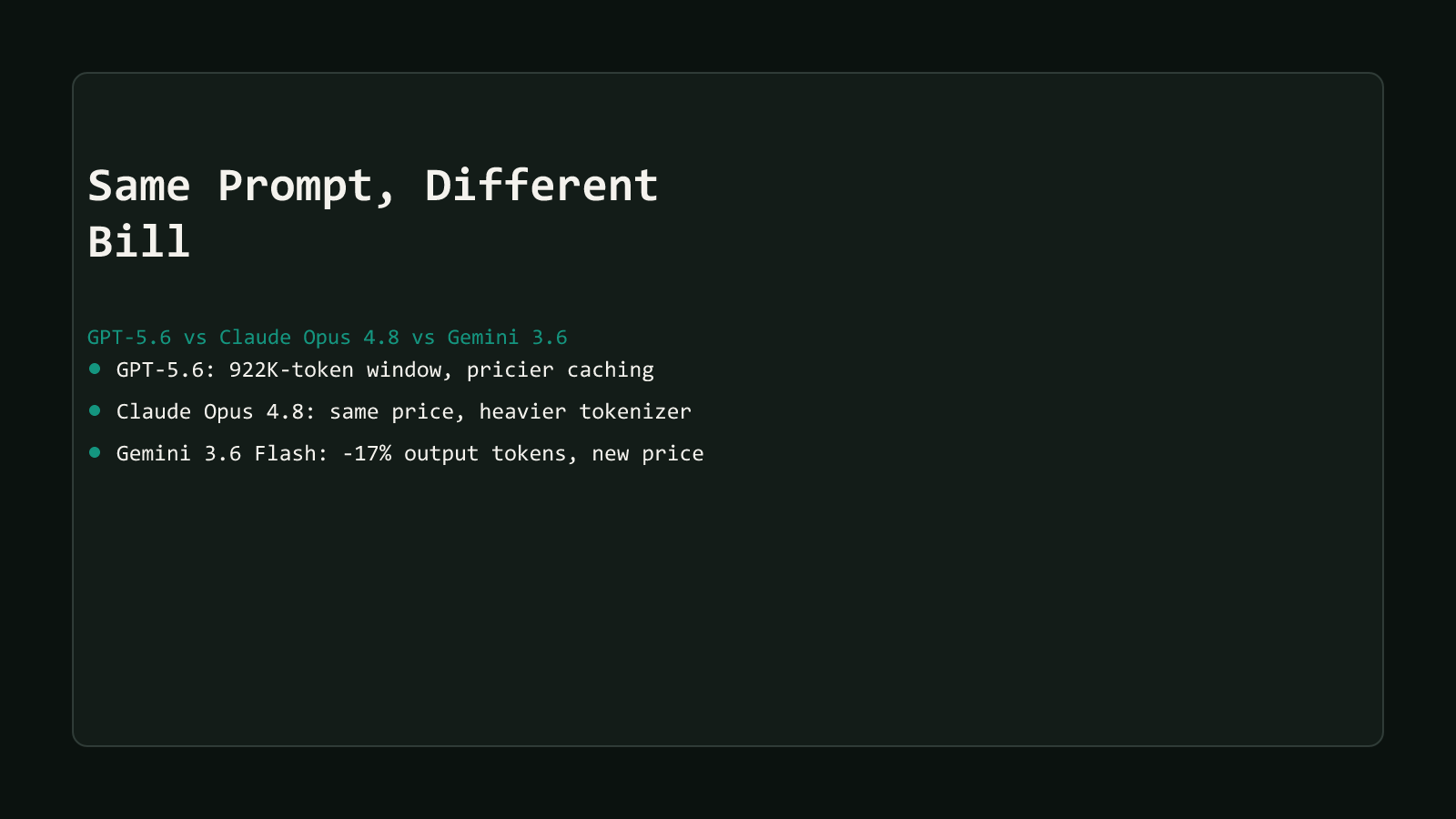
| OpenAI GPT-5.6 | Near-1M context window (up to 922K input, 128K output) on the o200k_base encoding | Prompt caching moved from free and implicit to explicit breakpoints, with a 1.25x premium on cache writes | GA 2026-07-09 | Paraphrased, aggregated from model-tracking sources, not OpenAI’s own announcement post directly |
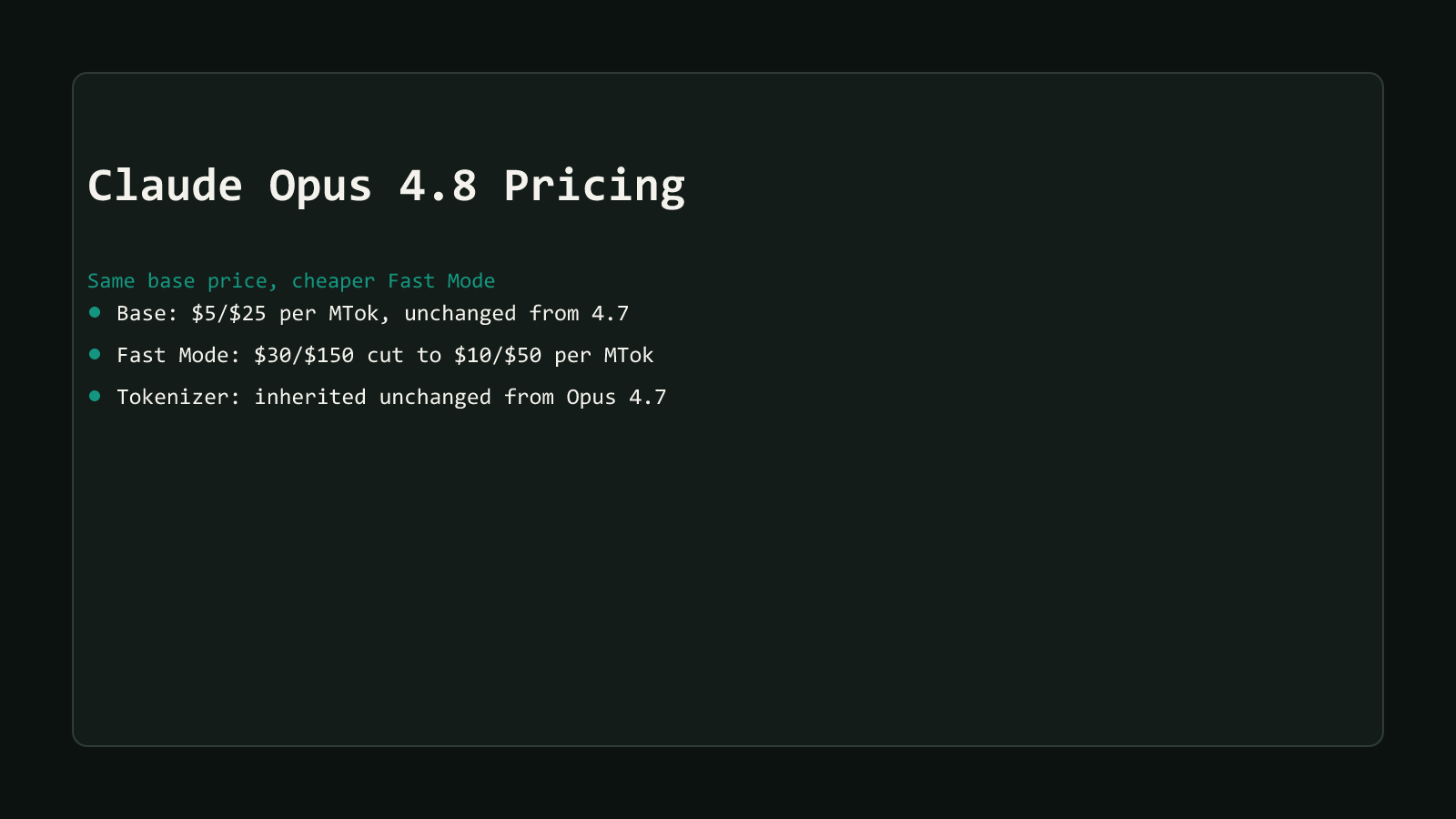
| Anthropic Claude Opus 4.8 | Tokenizer inherited from Opus 4.7 counts up to ~35% more tokens for the same text than pre-4.7 models | Base price unchanged ($5/$25 per MTok); Fast Mode cut from $30/$150 to $10/$50 per MTok | 2026-05-28 | Price paraphrased (third-party pricing coverage); tokenizer claim paraphrased, not in Anthropic’s own official GA changelog |
| Google Gemini 3.6 Flash | Uses 17% fewer output tokens than Gemini 3.5 Flash for comparable tasks | $0.75 / $3.75 per million input/output tokens now (through 2026-12-31), rising to $1.50 / $7.50 in 2027, 1M-token context window | 2026-07-21 | Paraphrased (token reduction) / confirmed on Google’s own pricing page (both price points) |
Every cell above carries its own confidence label on purpose. Two of the six numbers in this table (the context window figures and the tokenizer claim) come from secondary reporting, not a primary source Anthropic or OpenAI published themselves. That’s stated plainly rather than smoothed over, because a wrong number stated with confidence does more damage to a cost estimate than an honest “unconfirmed.”
OpenAI: a bigger window, and caching that finally costs something
GPT-5.6 reached general availability on 2026-07-09 with a context window reported at roughly 1.05M tokens, split into up to 922K input tokens and 128K output tokens. It uses the o200k_base encoding, the same one GPT-4o introduced, not the older cl100k_base encoding that GPT-3.5 and GPT-4 used.
That encoding detail is not trivia. A prompt that tokenizes to, say, 500 tokens under cl100k_base will not tokenize to the same count under o200k_base. This site’s own AI Token Counter currently implements cl100k_base only, which is accurate for GPT-3.5 and GPT-4-family models but not for GPT-5.6’s o200k_base encoding. That’s a real, current limitation, and it’s disclosed directly on the tool’s own comparison table rather than left for a reader to discover after the fact.
The other change is quieter but hits every high-volume integration: OpenAI’s earlier free, automatic prompt caching is gone in favor of explicit cache breakpoints, a 1.25x premium on cache writes, and a 30-minute minimum time-to-live. Cache reads still carry roughly the same 90% discount as before. If your integration leaned on “caching just happens” without configuring breakpoints, it’s paying the new write premium without getting the read discount to offset it.
Legacy models have a real shutdown date
If anything in your codebase still points at gpt-4, o1, or o4-mini,
those model IDs stop responding on October 23, 2026. This is confirmed
directly from OpenAI’s own deprecations
page, not third-party
reporting: OpenAI states a minimum six-month notice period for generally
available models, and lists gpt-5.6-sol and gpt-5.6-terra as the named
replacements. Migrating early also means re-checking token counts against the
new o200k_base encoding, not just swapping the model string.
Anthropic: same sticker price, a heavier tokenizer
Claude Opus 4.8 launched 2026-05-28 at the same base price as Opus 4.7: $5 per million input tokens, $25 per million output tokens, confirmed on Anthropic’s own Claude pricing page. On its own, that reads as “no change.” Fast Mode tells a different story: its price dropped from $30/$150 per million tokens to $10/$50, a real cut for anyone running latency-sensitive workloads that specifically pay for Fast Mode.
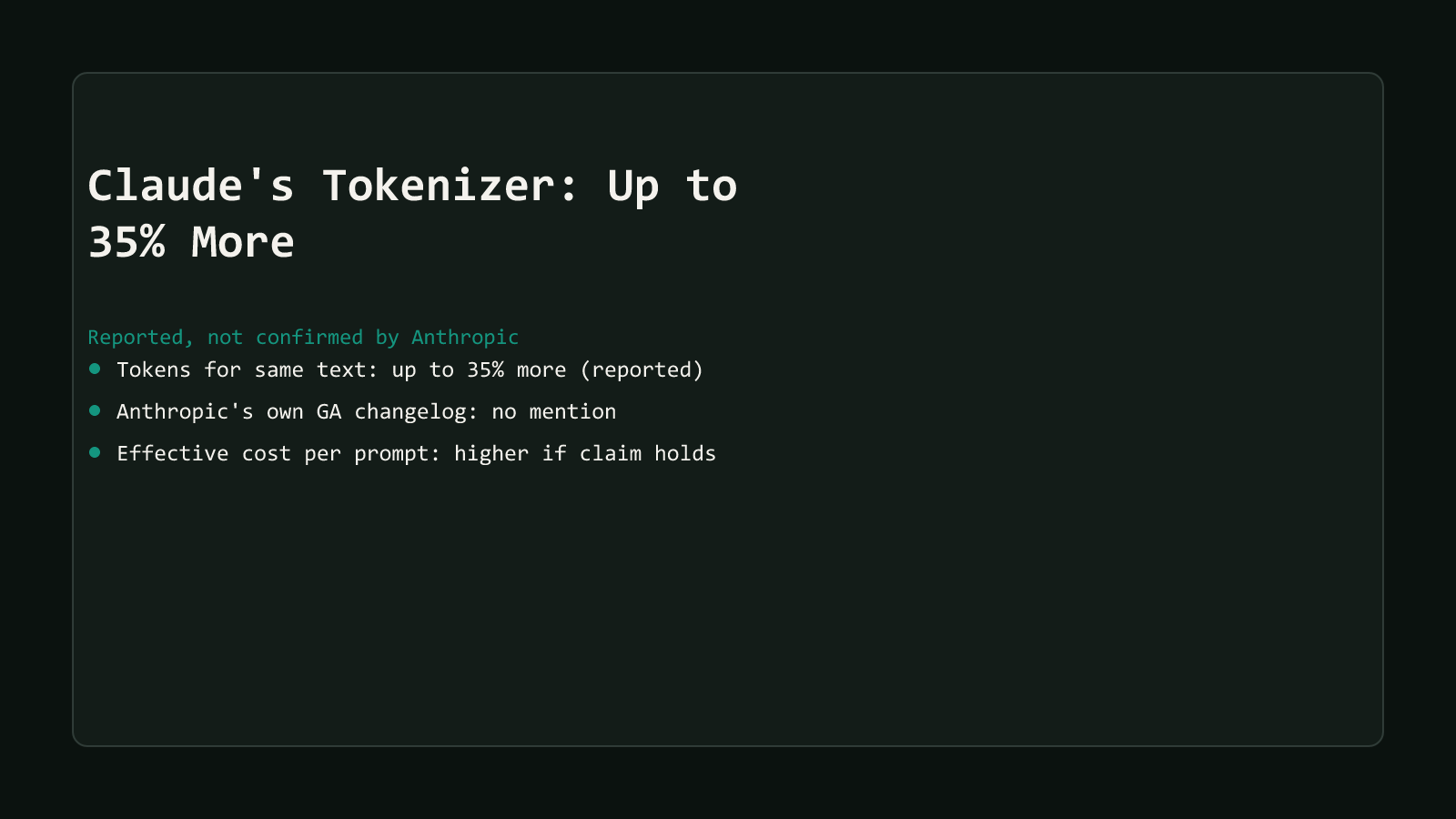
The harder number to verify is the tokenizer. Third-party technical coverage reports that the tokenizer Opus 4.7 introduced, and that Opus 4.8 inherited unchanged, counts up to roughly 35% more tokens for the same input text than the tokenizer pre-4.7 models used. A direct read of Anthropic’s own official GitHub changelog announcing Opus 4.7’s general availability does not mention a tokenizer change anywhere, only general performance claims. That gap is worth stating outright rather than papering over: the 35% figure is plausible, widely repeated, and unconfirmed by Anthropic directly.
The practical effect, if the figure holds: the same price per token does not mean the same price per prompt. If your text now tokenizes to more tokens than it used to, your cost per call goes up even though the rate card looks unchanged. A budget built by multiplying an old token count by a new price will be wrong twice over.
Opus 4.7 also introduced a real breaking change worth flagging for anyone touching the API directly: passing temperature, top_p, top_k, or budget_tokens now returns an HTTP 400 error under some configurations, according to the same third-party technical coverage, again not called out in Anthropic’s own GA changelog. If a call that used to work suddenly 400s after an upgrade, check those parameters first.
Google: Gemini 3.6 Flash spends fewer tokens, not just less money
Gemini 3.6 Flash launched 2026-07-21 at $0.75 per million input tokens and $3.75 per million output tokens, confirmed directly on Google’s own Gemini API pricing page, with a 1M-token context window. That same page states the rate rises to $1.50 input / $7.50 output on 2027-01-01, a scheduled increase worth budgeting around separately. Reported separately from the price: it uses 17% fewer output tokens than Gemini 3.5 Flash for comparable tasks, according to tech-press launch coverage rather than a Google blog post directly.
That’s two levers moving independently. A cheaper per-token rate lowers cost on its own. A model that genuinely produces fewer output tokens for the same task lowers cost again, on top of the rate change. Comparing only the sticker price between 3.5 Flash and 3.6 Flash understates the real difference, because it misses the second lever entirely.
Read the real count straight from the API, not a blog post
Every provider’s own API response already carries the real, billed token count. You don’t need an estimate if you can make a live call: OpenAI’s Chat Completions response includes a usage object, Anthropic’s Messages API includes its own usage object with different field names, and Google’s Gemini API includes a usageMetadata object. The shapes differ slightly across providers, which is itself a small but real integration detail:
"usage": {
  "prompt_tokens": 812,
  "completion_tokens": 194,
  "total_tokens": 1006
}"usage": {
"input_tokens": 812,
"output_tokens": 194
}"usageMetadata": {
"promptTokenCount": 812,
"candidatesTokenCount": 194,
"totalTokenCount": 1006
}The field names above are illustrative placeholders, not a captured live call, but the shape matches each provider’s own documented response schema. If you need a certain answer for a specific prompt, a real call and its usage/usageMetadata field beats any estimate, including the ones in this post.
If you just want a fast, no-API-key check before you commit to a call, that’s exactly what this site’s AI Token Counter is for: paste a prompt once and see an exact GPT count next to clearly-labeled Claude and Gemini estimates, side by side, entirely in your browser. The LLM Pricing Calculator takes that same prompt and turns it into the actual side-by-side dollar comparison this post has been building toward.
Don’t let this comparison go stale either
Every number in this post has a real date attached to it, on purpose. Six months from now, at least one of these providers will likely ship another change, and a reader who bookmarks this page instead of re-checking it will be making the same mistake this post is warning against. Treat any cost comparison, including this one, as a snapshot, not a constant. Before a budget review or a provider switch, run your actual prompts through the AI Token Counter and the LLM Pricing Calculator, and check the provider’s own pricing page for the current rate, rather than trusting a number that was accurate the day it was written.
Browse more coverage like this in the AI Productivity archive.