
What’s actually enforced, and when
GitHub’s changelog states the version floor directly:
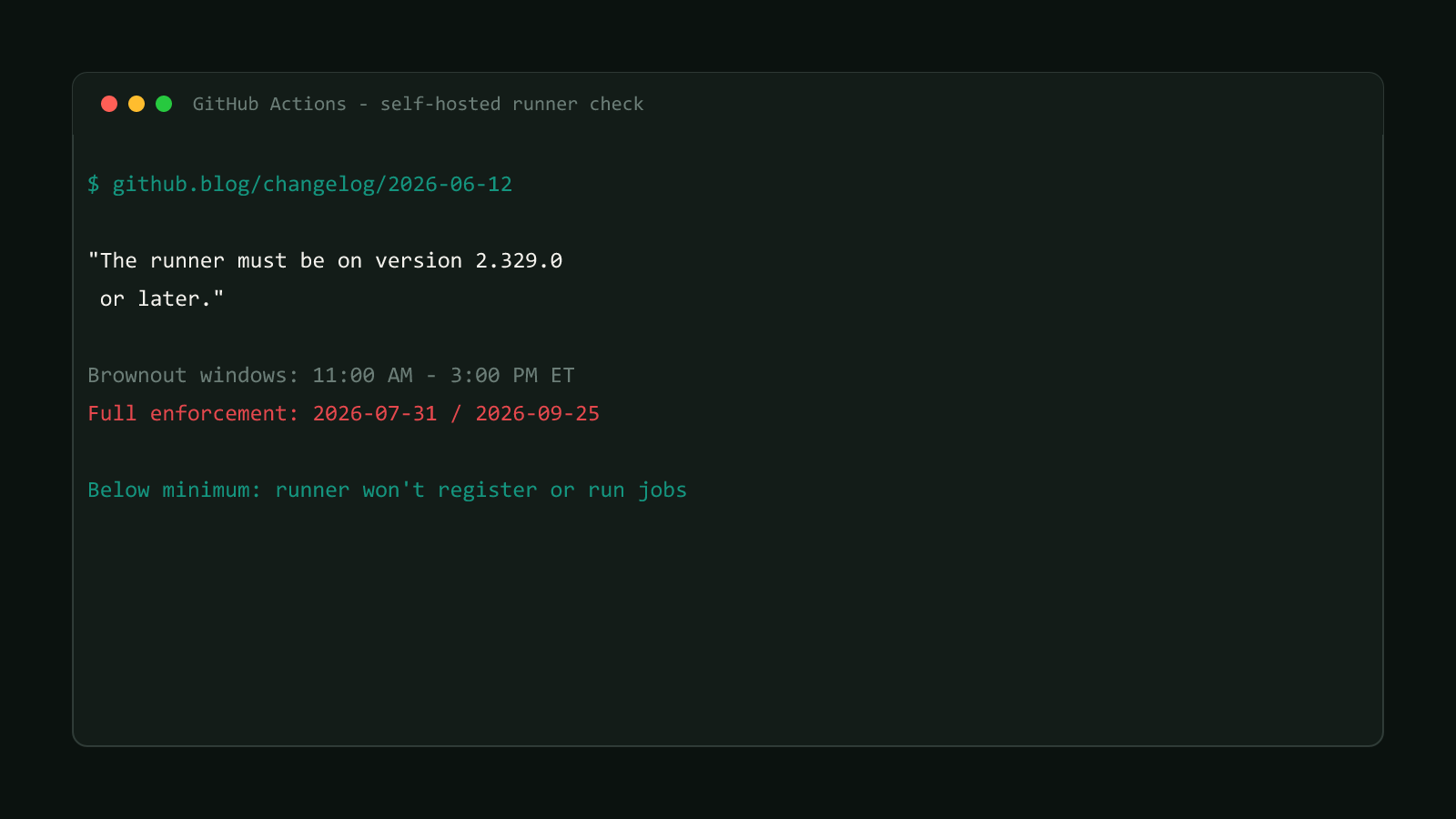
“The runner must be on version 2.329.0 or later.”
A second, separate requirement rides alongside it:
“The runner must stay up to date by installing each new runner release within 30 days of its publication.”
That second rule is a rolling window, not a one-time bump. A runner that’s on 2.329.0 today but skips the next few releases can drift back out of compliance a few months from now.
Runners with auto-update enabled satisfy the 30-day rule without anyone touching them, since GitHub’s own guidance confirms auto-update installs each release well inside that window. Manually managed runners are the ones actually at risk here.
Enforcement isn’t a single flip-the-switch date. It rolls out as four weeks of brownout windows, each one a four-hour block scheduled for late morning through early afternoon Eastern time, progressively expanding in scope: early windows only block new runner registrations during that slot, later windows also start blocking job execution on outdated runners during the window. Full, permanent enforcement follows the brownout schedule: 2026-07-31 for GitHub Enterprise Cloud with Data Residency, 2026-09-25 for standard GitHub Enterprise Cloud.
What this looks like if you're unprepared
An outdated runner doesn’t throw a clear “upgrade your runner” error during a brownout window. It just stops picking up jobs, or fails to register, for that four-hour window and then works again. That reads as flaky infrastructure, not a version problem, unless you already know the schedule exists. Once full enforcement lands, the same failure becomes permanent instead of a four-hour window.
Structural Comparison Matrix
| Operational Aspect | Runner below 2.329.0 / stale install | Runner on 2.329.0+, updated within 30 days |
|---|---|---|
| During a brownout window (11am-3pm ET) | Registration or job pickup blocked | Unaffected |
| Outside a brownout window, pre-enforcement | Works normally, still non-compliant | Works normally |
| After full enforcement date | Can’t register; existing runner stops jobs | Unaffected |
| Maintenance burden | Manual version checks needed indefinitely | None, if auto-update is enabled |
Checking and upgrading your runner version
Run this on the machine hosting the self-hosted runner to see what it’s currently on:
# From the runner's install directory
cat .runner_version 2>/dev/null || ./config.sh --version
If it reports anything below 2.329.0, or you don’t know when it last updated, upgrade it. GitHub Actions runners support auto-update by default unless it was explicitly disabled; check the runner service configuration first:
# Check whether auto-update is disabled for this runner
cat .runner | grep -i "disableupdate"
If auto-update is off, or you manage runners at a scale where you don’t want to rely on it, download and install the current release directly from the runner releases page, then restart the runner service so it picks up the new binary:
# Example for a Linux x64 runner - use the current release asset URL
curl -o actions-runner-linux-x64.tar.gz -L \
  https://github.com/actions/runner/releases/download/v2.329.0/actions-runner-linux-x64-2.329.0.tar.gz
tar xzf ./actions-runner-linux-x64.tar.gz
sudo ./svc.sh stop
sudo ./svc.sh start
At fleet scale, script the version check across every self-hosted runner group before the brownout windows start rather than finding out one at a time when a job silently stops queuing.
Does this affect this site’s own workflows?
No, and it’s worth saying so plainly rather than forcing a first-person angle that isn’t real. This site’s .github/workflows/ci.yml runs entirely on GitHub-hosted ubuntu-latest runners for both the build and deploy jobs, never a self-hosted runner. The enforcement covered here is scoped specifically to self-hosted runner registration and job execution; GitHub-hosted runners are versioned and managed by GitHub itself and sit outside this change entirely.
This cluster is still worth knowing if you run Actions at scale with your own infrastructure, self-hosted runners are common wherever a team needs specific hardware, network access, or licensing that GitHub-hosted runners can’t provide. If that’s your setup, the brownout schedule is the part most teams miss: it’s already running in the weeks before full enforcement, not a future date you can safely ignore until it arrives.
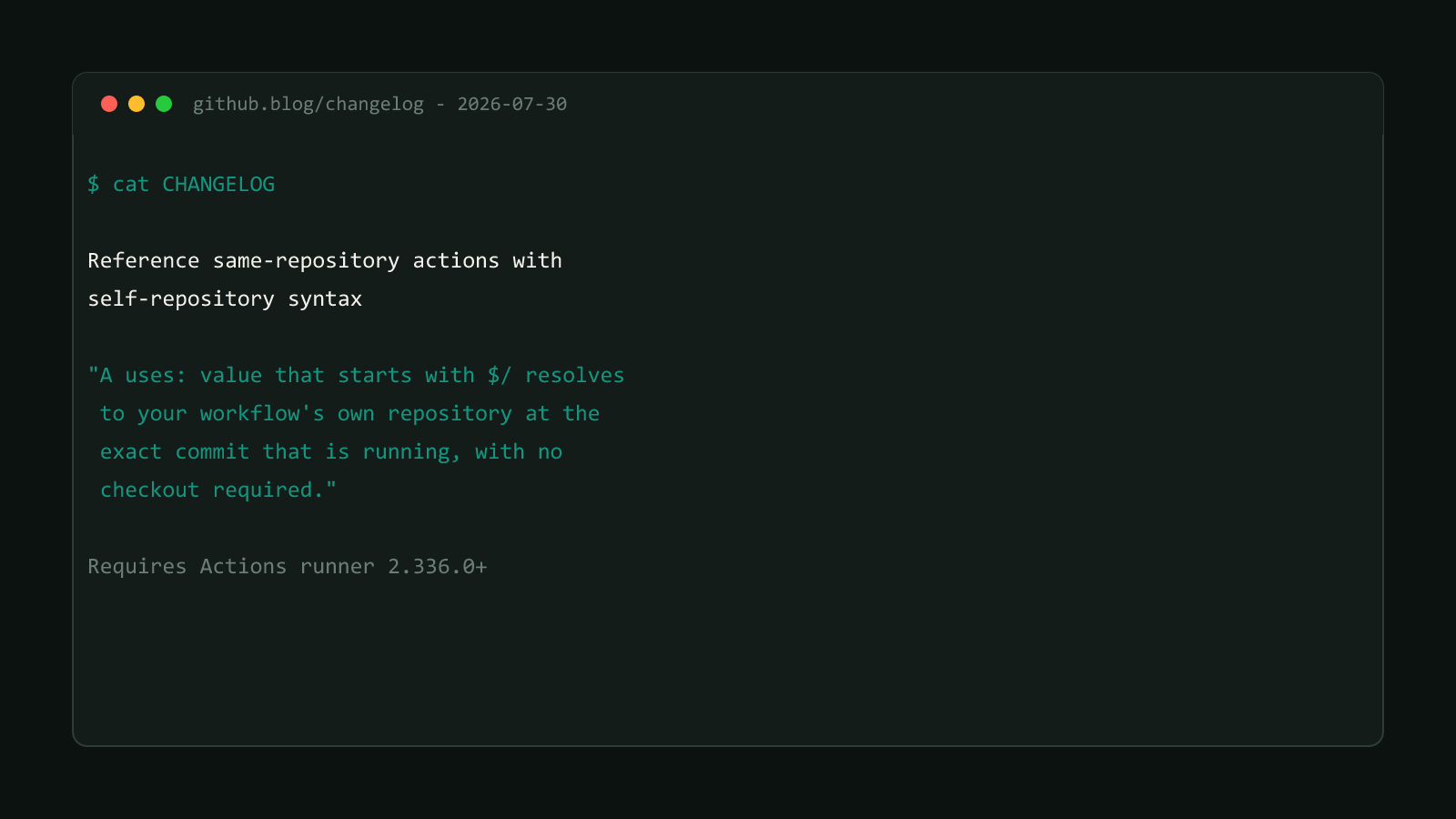
A separate but related change lets you reference same-repository actions with a new $/ syntax, which requires Actions runner 2.336.0 or later, a different, higher version floor than the 2.329.0 registration minimum covered here. Don’t conflate the two version requirements if you’re checking both.
Source
GitHub’s changelog entry on the self-hosted runner version cutoff (2026-06-12). Browse more posts like this in the Dev Tools archive.