
The gap this closes
Before this feature, anyone with write access to a repository could modify a workflow file to run arbitrary code with that repo’s secrets, and any event GitHub Actions supports (push, pull_request_target, workflow_dispatch, and the rest) could trigger a workflow with nothing standing in front of it. There was no repo-level or org-level control over who was allowed to cause a workflow to run, or which event types were even legitimate for a given repo’s actual usage pattern.
GitHub’s changelog describes the fix plainly:
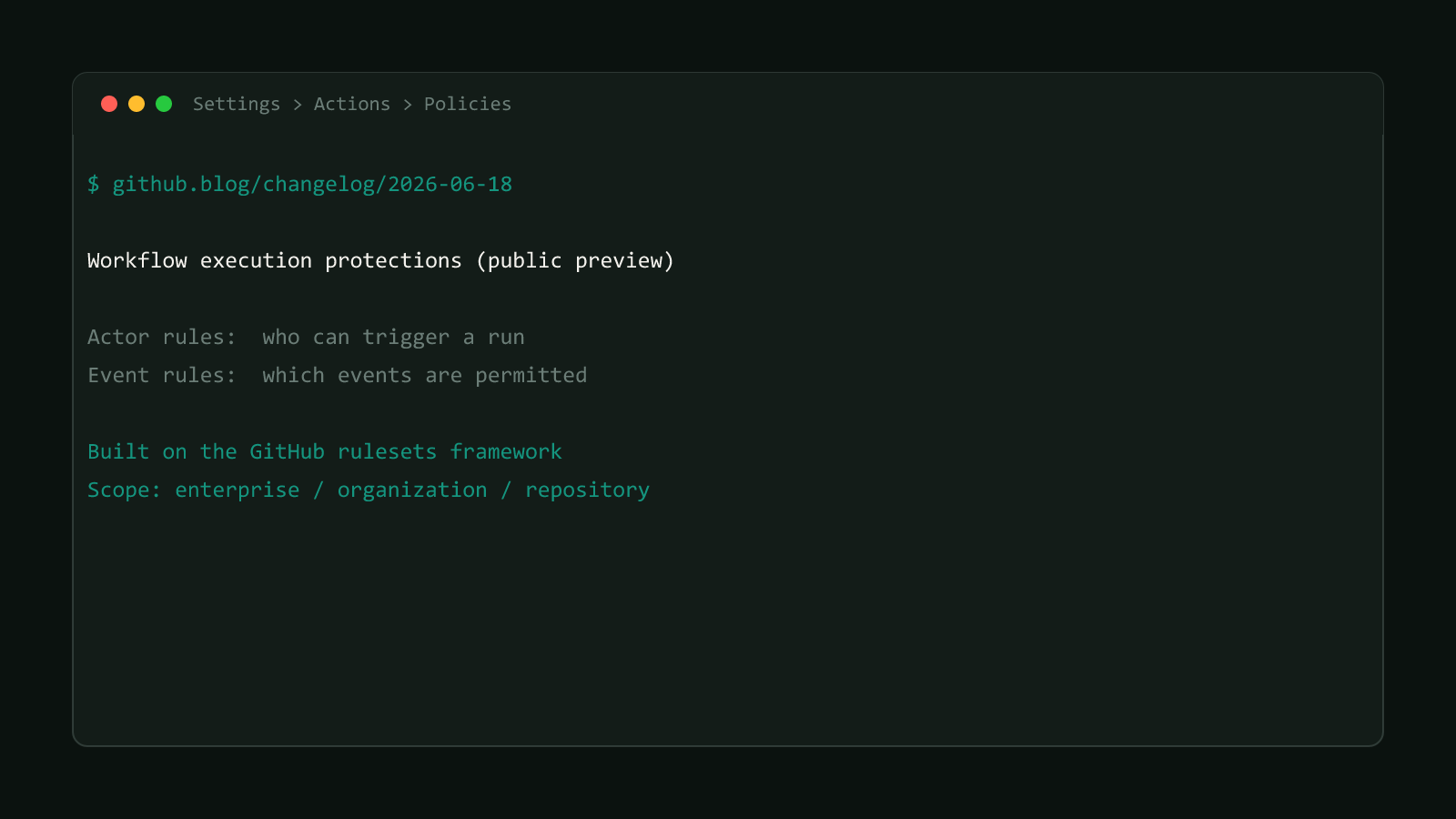
“Workflow execution protections are now in public preview for GitHub Enterprise, organizations, and repositories” and let you “define an allow list that controls who can trigger GitHub Actions workflows and which events are permitted to run them.”
The feature is “built on the GitHub rulesets framework,” which means it inherits rulesets’ existing concepts, including an evaluate mode that reports exactly what a rule would have blocked without actually stopping any runs, so you can roll a new policy out and check its real-world impact before switching it to active enforcement, rather than introducing a parallel permissions system to learn from scratch.
Actor rules vs. event rules
The two rule types are independently configurable, and most real policies use both together.
Actor rules control who can trigger a workflow at all. Straight from GitHub’s own description:
“Individual users, repository roles (e.g., Read, Maintain, and Admin), GitHub Apps, Copilot, and Dependabot.”
That’s the piece that separates “who can push code” from “who can cause a workflow to execute,” a distinction that didn’t exist as an enforceable setting before.
Event rules control which trigger types are permitted, regardless of who fires them. pull_request_target is the one worth allow-listing carefully; ordinary triggers like push and workflow_dispatch are lower risk, and pull_request sits somewhere between the two depending on what the workflow actually does. A repo that has no legitimate reason to ever run a workflow off pull_request_target can block that event type outright, independent of who’s involved.
Structural Comparison Matrix
| Operational Aspect | Before | After (workflow execution protections) |
|---|---|---|
| Who can trigger a workflow run | Anyone with write access, no separate control | Allow-listed by actor rule |
| Which event types can run at all | Every event Actions supports, no restriction | Allow-listed by event rule |
| Testing a new policy before enforcing | No built-in dry-run | Evaluate mode shows would-be blocks first |
| Configuration scope | N/A (no equivalent existed) | Repository, organization, or enterprise |
Setting up a policy
This lives in a new “Policies” section under Actions settings, layered on rulesets:
-
Navigate to the right level. For a single repository: Settings → Actions → Policies. For an organization-wide rule: the organization’s own Settings → Actions → Policies, which can apply across every repo in the org.
-
Create a new ruleset scoped to workflow execution. Give it a name and decide whether it targets specific repositories (via repository custom properties, at the org/enterprise level) or the whole scope you’re configuring it at.
-
Add actor rules. Start narrow: allow specific repository roles (
Write,Maintain,Admin) or specific GitHub Apps, rather than defaulting to “everyone with write access.” -
Add event rules. List only the trigger events your workflows actually use. If nothing in the repo legitimately needs
pull_request_target, don’t allow-list it, even if no current workflow uses it; this closes the door on someone adding one later without review. -
Set the ruleset to evaluate mode first, rather than jumping straight to enforcement. Let it run for a normal work cycle (a week is reasonable) and review what it would have blocked.
-
Switch to active enforcement once evaluate mode shows no unexpected blocks against real usage.
Pair this with the checkout-level fix
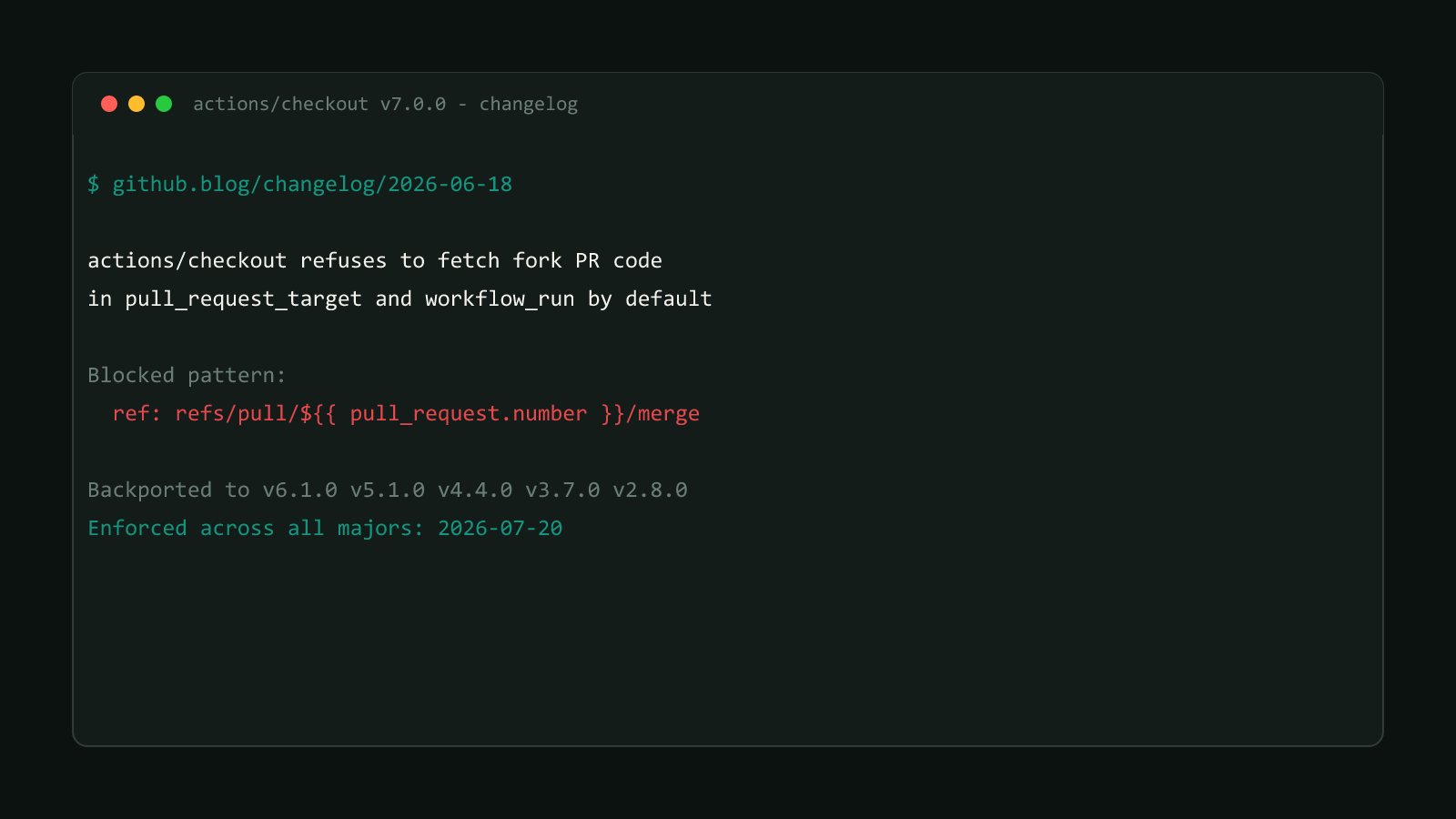
Workflow execution protections and actions/checkout v7’s
pull_request_target block address the same fork-PR attack surface from
different angles: this feature decides whether the workflow runs at all for a
given actor or event, while the checkout change stops a specific unsafe
checkout pattern inside a workflow that’s already running. See
actions/checkout v7 Blocks pull_request_target
PRs for the
complementary control. Neither one alone covers the whole attack surface.
Does this apply to a repo like this site’s?
Yes, and this is one of the changes in this series where a single repository genuinely doesn’t need an Enterprise plan or an organization admin to benefit. Per GitHub’s own docs, workflow execution protections are configurable “at the enterprise, organization, and repository level,” so a solo-maintained repo can opt in through its own Settings → Actions → Policies the same way an org-wide policy would be configured, just scoped to one repository instead of many.
Source
GitHub’s changelog entry introducing this allow-list feature (2026-06-18), corroborated by GitHub’s own docs page on the feature. Browse more posts like this in the Dev Tools archive.