
Structural Comparison Matrix
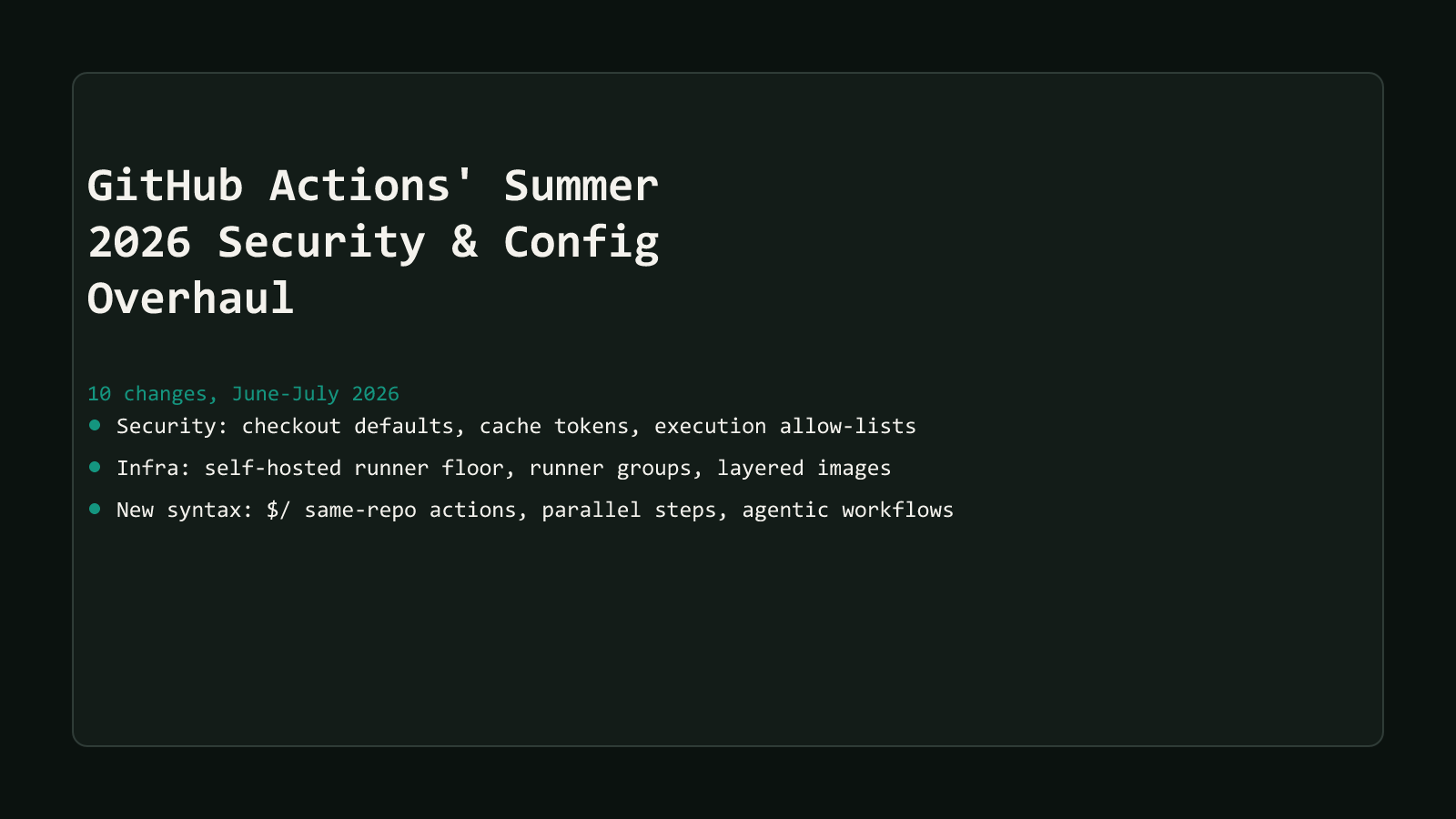
| # | Change | Type | Applies to you if… |
|---|---|---|---|
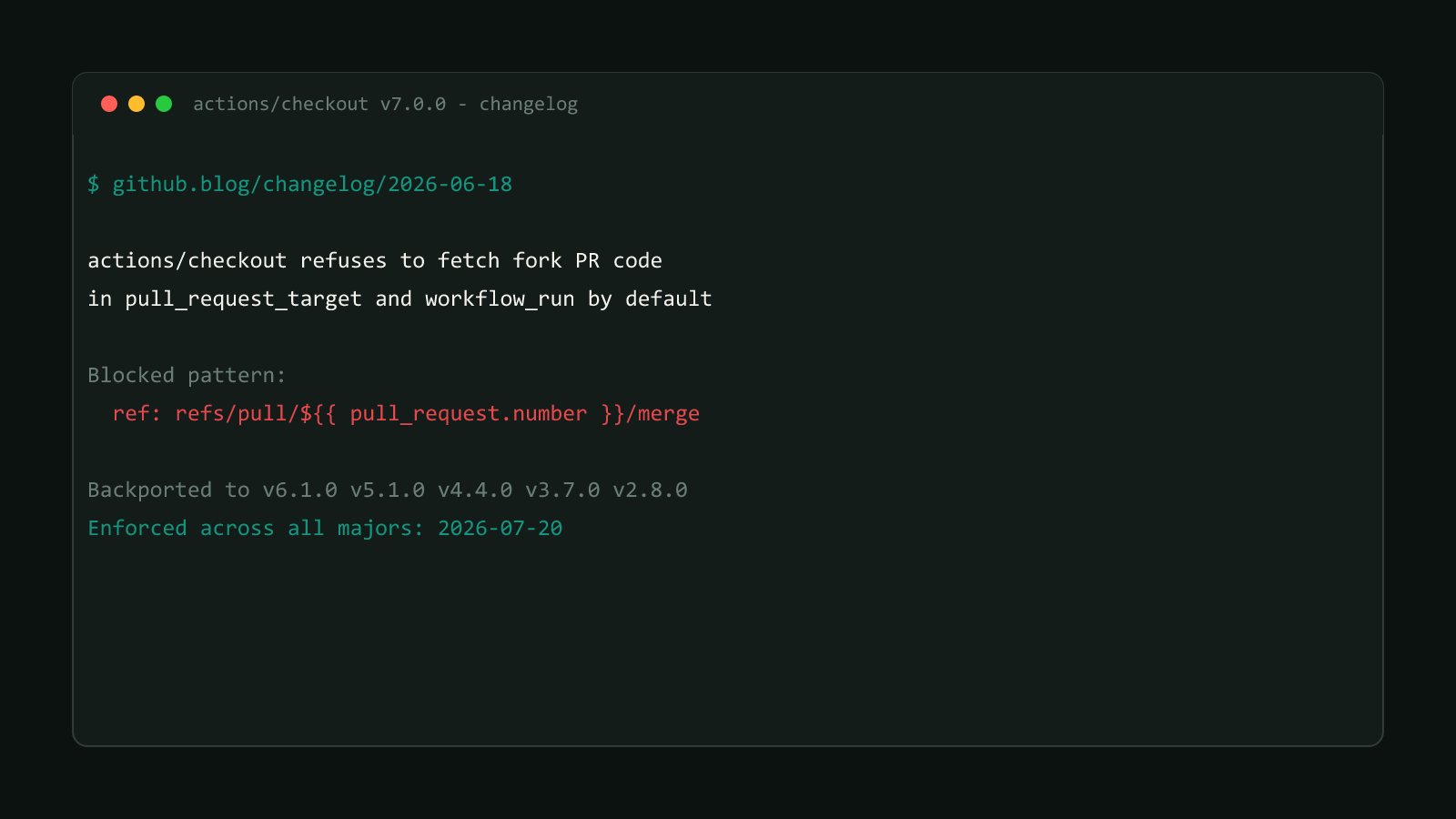
| 1 | actions/checkout v7 blocks fork PR checkouts | Breaking (security) | You use pull_request_target or PR-flavored workflow_run with fork checkouts |
| 2 | Self-hosted runner minimum version enforced | Deprecation cutoff | You run self-hosted Actions runners |
| 3 | Workflow execution protections (allow-lists) | New security control | You want to restrict who/what can trigger workflows |
| 4 | Bot-created PRs need approval to run workflows | Behavior default | A scheduled workflow in your repo opens PRs as github-actions[bot] |
| 5 | Actions cache goes read-only on untrusted triggers | Security tightening | You populate a shared cache from a pull_request_target-style trigger |
| 6 | $/ same-repository action syntax | New syntax | You reference a composite action or reusable workflow in the same repo |
| 7 | Parallel steps via background/wait/parallel | New capability | Your workflow has independent steps forced into artificial sequence |
| 8 | Restrict GitHub-hosted runners to named groups | New control (Team/Enterprise) | You’re on a Team/Enterprise plan and want to gate standard runner labels |
| 9 | Layered custom runner images | New capability | You maintain custom runner images and duplicate a shared base image today |
| 10 | GitHub Agentic Workflows (public preview) | New capability | You want AI agents doing reasoning tasks (triage, CI analysis) inside CI |
Every row is confirmed against GitHub’s own changelog entry for that change, not summarized from memory. Full mechanism, exact quoted text, and the fix live in each linked post below.
The 10 changes, in detail
- actions/checkout v7 Blocks pull_request_target PRs: closes the classic “pwn request” hole where a workflow with real secrets checks out an attacker-controlled fork commit.
- GitHub Actions: Upgrade Self-Hosted Runners by Jul 31: a minimum runner version (2.329.0+) and a rolling 30-day update window, enforced through escalating brownout windows.
- Set Up GitHub Actions Workflow Execution Protections: a rulesets-based allow-list controlling who can trigger workflows and which events are permitted at all.
- Approve Workflow Runs From github-actions[bot] PRs: bot-authored PRs can now trigger CI, but only after a collaborator explicitly approves the run.
- GitHub Actions Cache Goes Read-Only on Untrusted Triggers: closes a cache-poisoning path where an external contributor could write to a default-branch cache scope.
- Reference Same-Repo Actions With $/ Syntax: resolves a same-repo action to the exact running commit, no checkout step required.
- Run GitHub Actions Steps in Parallel With background:
background: true,wait,wait-all,cancel, andparallelbring real concurrency inside a single job’s step list. - Restrict GitHub-Hosted Runners to Named Runner Groups: Team/Enterprise admins can disable standard labels like
ubuntu-latestorg-wide and force named runner groups instead. - Build Custom GitHub Actions Runner Images in Layers: compose custom runner images on top of other custom images instead of duplicating a shared base.
- Set Up GitHub Agentic Workflows in Actions: compiles natural-language Markdown into standard Actions YAML, sandboxed behind an Agent Workflow Firewall with read-only defaults.
Why this happened in one summer
GitHub ships Actions changes on a rolling basis, but June and July 2026 concentrated an unusual amount of security-hardening into a seven-week window: a real breaking default aimed squarely at the “pwn request” pattern, two more security controls closing adjacent gaps (cache poisoning, unapproved bot-triggered runs), and a version-enforcement push for self-hosted infrastructure — alongside a separate cluster of new capability (parallel steps, same-repo action syntax, agentic workflows) that reads more like a normal feature cadence. None of the dates or quoted text above are estimated; every one traces to GitHub’s own changelog, cross-checked per cluster against the individual changelog post and, where one exists, GitHub’s own docs page for that feature.
Browse the rest of the Dev Tools archive for more CI/CD and Cloudflare Workers coverage.