
Structural Comparison Matrix
| Operational Task | Before v2.94.0 | gh CLI v2.94.0+ |
|---|---|---|
| Set a parent issue | GitHub.com issue sidebar, or a handwritten gh api graphql mutation | gh issue edit <number> --parent <number> |
| Link a sub-issue from the parent | Add it through the sub-issues panel in the web UI | gh issue edit <parent> --add-sub-issue <number> |
| Read an issue’s hierarchy | Open the issue page and scroll to the sub-issues panel | gh issue view <number> --json parent,subIssues,subIssuesSummary |
| Set a cross-issue dependency | No dedicated UI control; scripted against the GraphQL API | gh issue edit <number> --add-blocked-by <number> |
| Filter issues by type | type: qualifier in the web search bar | gh issue list --type <name> |
Check your gh version before any of this works
gh --versionEvery flag in this post needs GitHub CLI v2.94.0 or later. If your version is older, update through whatever channel installed gh: brew upgrade gh on Homebrew, winget upgrade --id GitHub.cli --source winget on Windows, or your Linux package manager. This machine is running v2.97.0, and every command below was run against that install.
Set, change, or remove a parent issue
gh issue edit takes one number or URL argument for the parent, straight from GitHub’s own manual page:
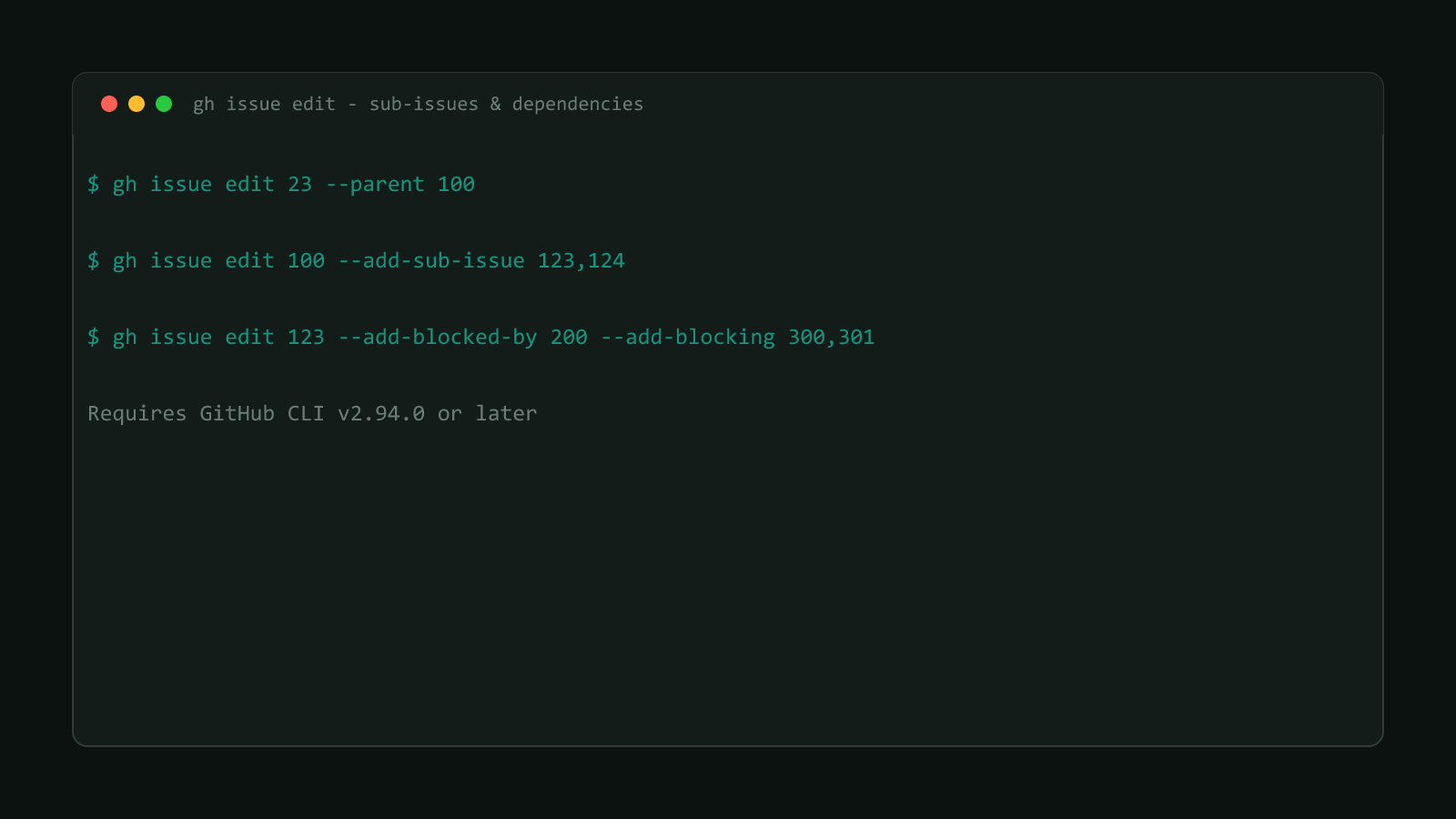
gh issue edit 23 --parent 100--parent does double duty. Run it once to link an unparented issue, or run it again later with a different number to move that issue under a new parent. There’s no separate flag for the two cases.
gh issue edit 23 --remove-parentGitHub’s own 2026-06-10 announcement describes the same capability this way:
Link, change, or remove a parent with
--parent,--set-parent, and--remove-parent.
That third flag doesn't exist in the shipped CLI
Running gh issue edit --help on a real v2.97.0 install shows only two flags
registered for parent handling: --parent and --remove-parent. The current
pkg/cmd/issue/edit/edit.go
source in cli/cli confirms it, just two calls to cmd.Flags() for this. A
script or an older tutorial that references --set-parent will fail with an
unknown-flag error. Use --parent for both the first link and any later
change; it does the job the announcement’s --set-parent describes.
Create a new issue directly as a sub-issue
gh issue create takes the same --parent flag, so a new issue can join the hierarchy at creation instead of needing a follow-up edit call:
gh issue create \
  --title "Fix login redirect loop after SSO callback" \
  --body "Users land back on /login after a successful SSO callback instead of the app." \
  --parent 100
The parent accepts a URL too, useful when the parent lives in a different repository: --parent https://github.com/cli/go-gh/issues/42, straight from the flag’s own documented example.
Link and unlink sub-issues from the parent side
The same relationship can be managed from the parent issue instead of the child, and --add-sub-issue takes a comma-separated list for more than one at a time:
gh issue edit 100 --add-sub-issue 123,124gh issue edit 100 --remove-sub-issue 124Read the hierarchy back with —json
gh issue view and gh issue list both expose parent, subIssues, and subIssuesSummary as JSON fields, so a script can read the tree without scraping HTML. Run against a real public issue on cli/cli itself, this is the actual shape gh returns:
gh issue view 5545 --repo cli/cli --json parent,subIssues,subIssuesSummary{
"parent": null,
"subIssues": { "nodes": [], "totalCount": 0 },
"subIssuesSummary": { "completed": 0, "percentCompleted": 0, "total": 0 }
}That particular issue has no sub-issues linked, which is why the fields are empty. When they’re populated, subIssues.nodes holds the full list of child issue objects, and subIssuesSummary gives a ready-made completed/total/percentCompleted count, so a script doesn’t have to iterate the array itself to show progress.
Set and filter by issue type
gh issue edit 23 --type Buggh issue edit 23 --remove-typegh issue list filters by the same field. This is real output from cli/cli’s own tracker, showing the full issueType object a populated field actually returns:
gh issue list --repo cli/cli --type Bug --limit 1 --json number,title,issueType[
{
"issueType": {
"id": "IT_kwDOA48Fh84AtH84",
"name": "Bug",
"description": "An unexpected problem or behavior",
"color": "RED"
},
"number": 9569,
"title": "Can't install / update `gh` due to expired GPG key?"
}
]Set cross-issue dependencies
Dependencies are separate from parent/child hierarchy. “Blocked by” and “blocking” describe ordering between two issues that don’t need a parent-child relationship at all:
gh issue edit 123 --add-blocked-by 200 --add-blocking 300,301Both flags take comma-separated lists, and both directions can be set in the same call, as shown in gh issue edit’s own --help output. Remove either side the same way:
gh issue edit 123 --remove-blocked-by 200gh issue create has the equivalent flags for setting dependencies at creation time: --blocked-by and --blocking, both accepting the same comma-separated issue-number or URL lists.
Where this fits in the wider gh CLI wave
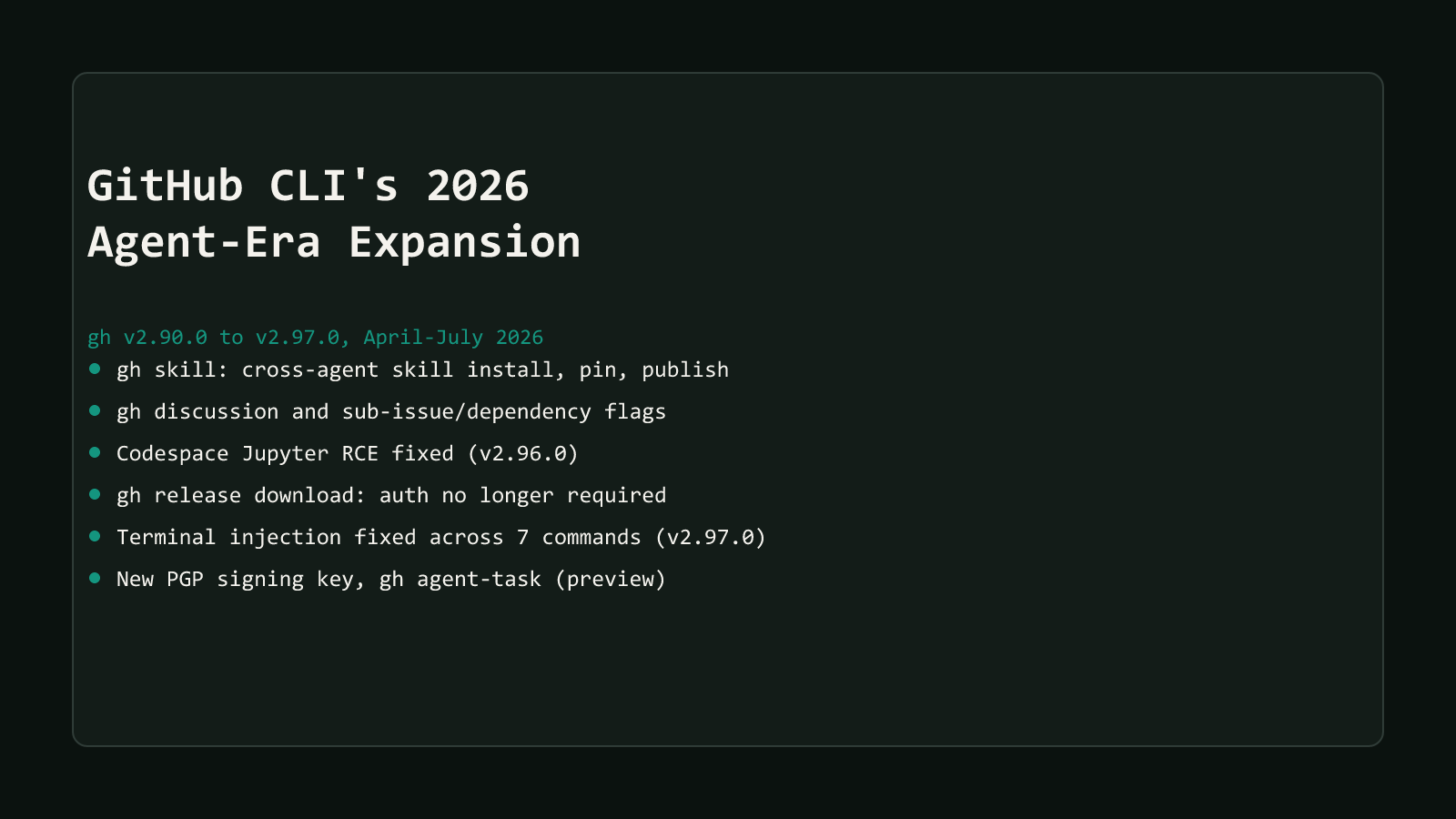
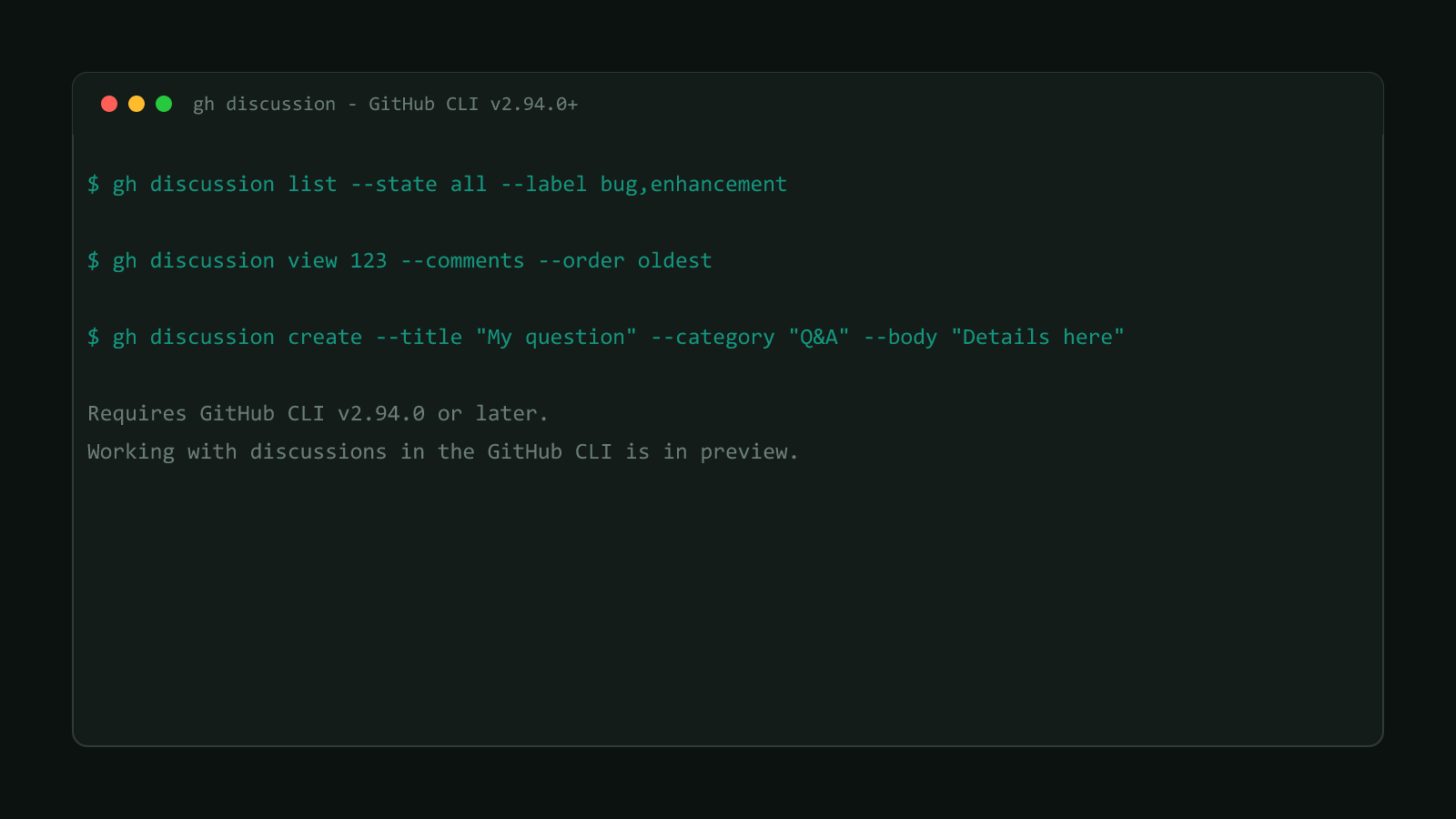
Sub-issue and dependency support shipped in the same v2.94.0 release as gh discussion, GitHub CLI’s new command group for GitHub Discussions. Neither depends on the other; they landed the same day because both closed a gap where GitHub.com had a feature gh couldn’t touch at all. See gh discussion: GitHub Discussions in Your Terminal for that side of the same release, and GitHub CLI’s 2026 Agent-Era Expansion for the full ten-part wave this cluster belongs to.
Reach for these flags the moment you’re managing more than a handful of issues in one hierarchy, triaging a big feature into sub-issues from a script, or wiring an agent to file work broken down by parent task automatically. For a one-off parent link on a single issue, the GitHub.com sidebar is still fewer keystrokes. Once you’re doing it more than once, gh issue edit --parent is the version that survives being scripted.
Browse more coverage like this in the Dev Tools archive.